

Researchers from Institut Teknologi Bandung (ITB) participated in the International Symposium on Intelligent Signal Processing and Communication Systems (ISPACS 2026), held at Park Hyatt Busan, Republic of Korea, from October 27 to 30, 2026.
Under the theme “Accelerating AI-driven Convergence of Signal Processing and Communication in the 6G Era,” the international symposium brought together researchers, academics, and professionals to exchange the latest developments in intelligent signal processing, communication systems, artificial intelligence, Internet of Things (IoT), and emerging technologies for next-generation networks.
ISPACS 2026 was chaired by Prof. Yeon Ho Chung of Pukyong National University, Republic of Korea, as the General Chair. According to the conference’s official program, ISPACS 2026 received 220 paper submissions, of which 157 papers were accepted for presentation, with participants representing 14 countries. The event was organized by the Busan-Ulsan-Gyeongnam Chapter of the Korean Institute of Communications and Information Sciences (KICS), with technical co-sponsorship from IEEE and IEEE Communications Society.
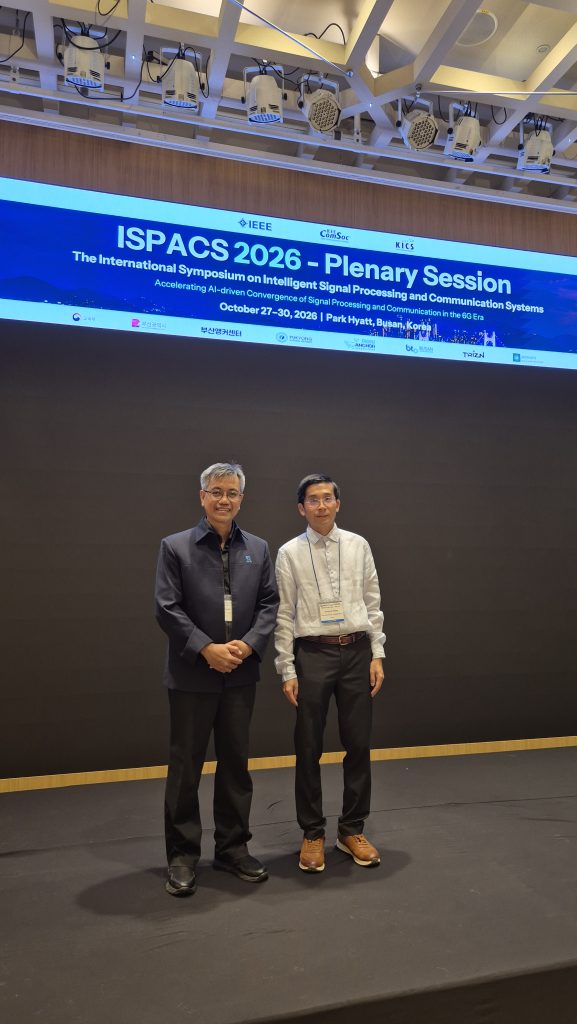
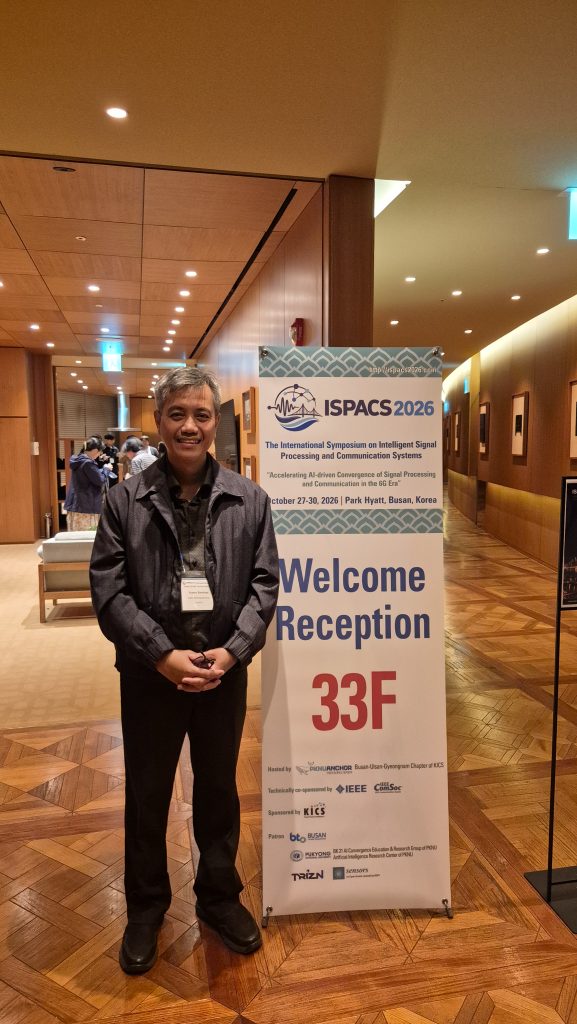
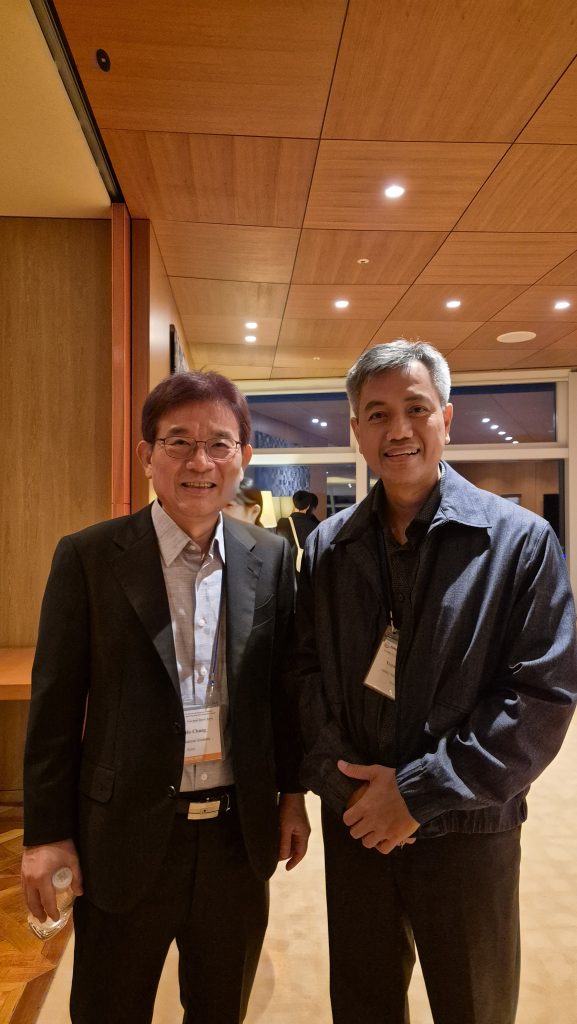
Prof. Yoanes Bandung from the ITB Research Center for ICT and School of Electrical Engineering and Informatics (STEI), Institut Teknologi Bandung, presented two research papers during Special Session III, entitled “Signal Processing, Hardware AI Accelerator, and IoT Application,” on October 29, 2026. The session was chaired by Prof. Trio Adiono of Institut Teknologi Bandung and provided a forum for discussing advances in signal processing, artificial intelligence hardware, and Internet of Things applications.
The two papers presented by the ITB research teams were:
- Analyzing the Role of User Perception in QoE Measurement for Video Streaming Services
The study investigates the role of user perception in measuring Quality of Experience (QoE) in video streaming services through sentiment-oriented analysis of 2,554 annotated social media comments collected from five video streaming platforms. By examining user feedback, the research identifies differences in how users perceive content quality and system performance across streaming services.

The findings show that content-related perceptions are predominantly positive (65.2%), indicating user satisfaction with content quality and availability. In contrast, system-related perceptions exhibit the highest proportion of negative feedback (69.7%), particularly concerning playback instability, authentication issues, and service accessibility. These results highlight the importance of incorporating user-centered perception analysis into QoE measurement to provide a more comprehensive assessment of video streaming service quality.
Authors: Yoanes Bandung, Fahmi Permana, Fetty Lubis, Armein Z. R. Langi, Dion Tanjung (Institut Teknologi Bandung); and Jong Deok Kim (Pusan National University, Republic of Korea).
- Temporal Gap-Driven Knowledge Distillation with Confidence Gating for Video Violence Detection
The study explores a knowledge distillation approach for video-based violence detection, focusing on the temporal and computational differences between teacher and student models. It investigates confidence-gated logit distillation, using X3D-M as the teacher model and X3D-XS as the student model, while examining differences in frame count, input resolution, and computational requirements.

Experiments across seven public datasets demonstrate that knowledge distillation is particularly effective in challenging real-world surveillance scenarios. However, it may also lead to negative transfer when the student model already performs well. These findings highlight the importance of confidence-based filtering of teacher predictions in developing efficient and robust lightweight AI models for video analytics and intelligent surveillance applications.
Authors: Yoanes Bandung, Irma Amelia Dewi, Kusprasapta Mutijarsa, Nugraha Utama, and Dion Tanjung (Institut Teknologi Bandung); and Jong Deok Kim (Pusan National University, Republic of Korea).
Both presentations highlight ITB’s ongoing research contributions in multimedia computing, communication systems, artificial intelligence, and intelligent video applications. They also demonstrate the outcomes of international research collaboration between Institut Teknologi Bandung and Pusan National University, particularly through joint research involving Prof. Jong Deok Kim.
ISPACS 2026 provided a valuable platform for disseminating research findings, exchanging ideas, and receiving feedback from the international research community. The participation also opened opportunities to strengthen academic networks and explore future collaborations in multimedia communication, AI-based video analytics, and next-generation intelligent systems.
Through its participation in international conferences, ITB continues to strengthen its global research presence and contribute to innovation in information and communication technology.
About ISPACS 2026
The International Symposium on Intelligent Signal Processing and Communication Systems (ISPACS) is an international academic forum established in 1992. It brings together researchers and professionals working in signal processing, communication systems, circuits and systems, artificial intelligence, and related technologies.
For more information, visit the official ISPACS 2026 website.


